

PERSISTENT READINESS SERIES · FIELD GUIDE
Persistent sensing solved the wrong half of the problem.
Persistent sensing gave you more data than your tools, your workflows, and your governance were built to handle.
The fix isn’t more AI. It’s architecture that absorbs the scale, so your team can focus their attention on where it actually matters.
THE PROBLEM
The Data Got Better. The Tools Didn't.
More data creates more signals; it also creates more noise. When the time it takes to filter through that noise eliminates the advantage of having real-time data, the question becomes: where is the actual value?

Signal Volume is Outpacing Triage
The volume of judgment calls has exploded. The criteria for making them haven't been formalized at the same pace.

Validation is Being Pushed Earlier than Confidence
Teams are expected to assess signals before certainty exists, but the thresholds for "enough to act" haven't kept up with compressed timelines.

Escalation has Become Improvised
Without predefined thresholds, the answer depends on who's on shift, how risk-averse they are, and whether they can afford to be wrong.

Context is Rebuilt from Scratch Every Time
Imagery in one system, OSINT elsewhere, maritime data separate. Every time a signal appears, analysts reconstruct the world around it manually, every single time.
The shift from detection to decision is already happening.
Is your architecture ready?
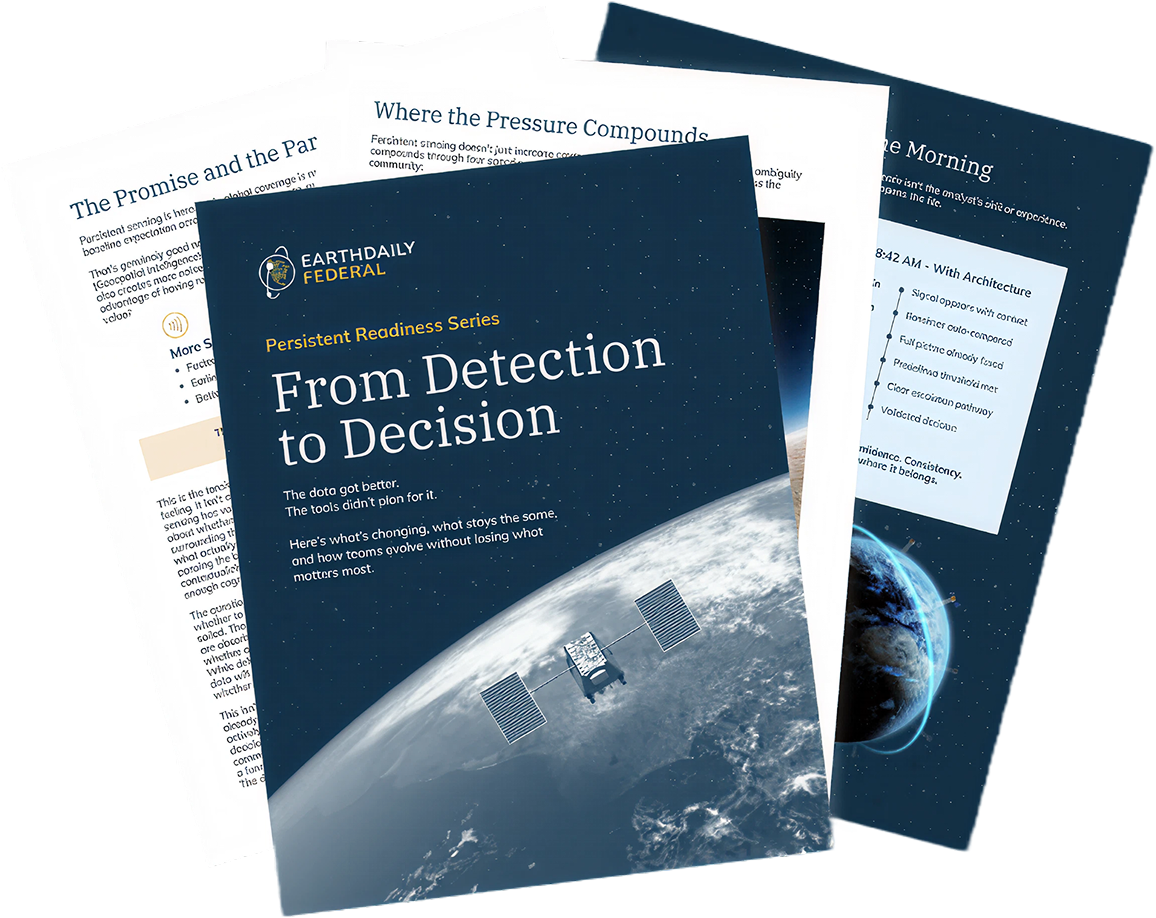
Download the Guide →

THE PRINCIPLE
The line that matters most.
“Machines absorb scale. Humans retain judgment.”
This boundary isn’t a philosophical position. It’s a design requirement.

DOWNLOAD THE GUIDE
The shift from detection to decision is already happening. Is your architecture ready?
Download the guide to see where your team stands and what comes next.
Download the Guide →